
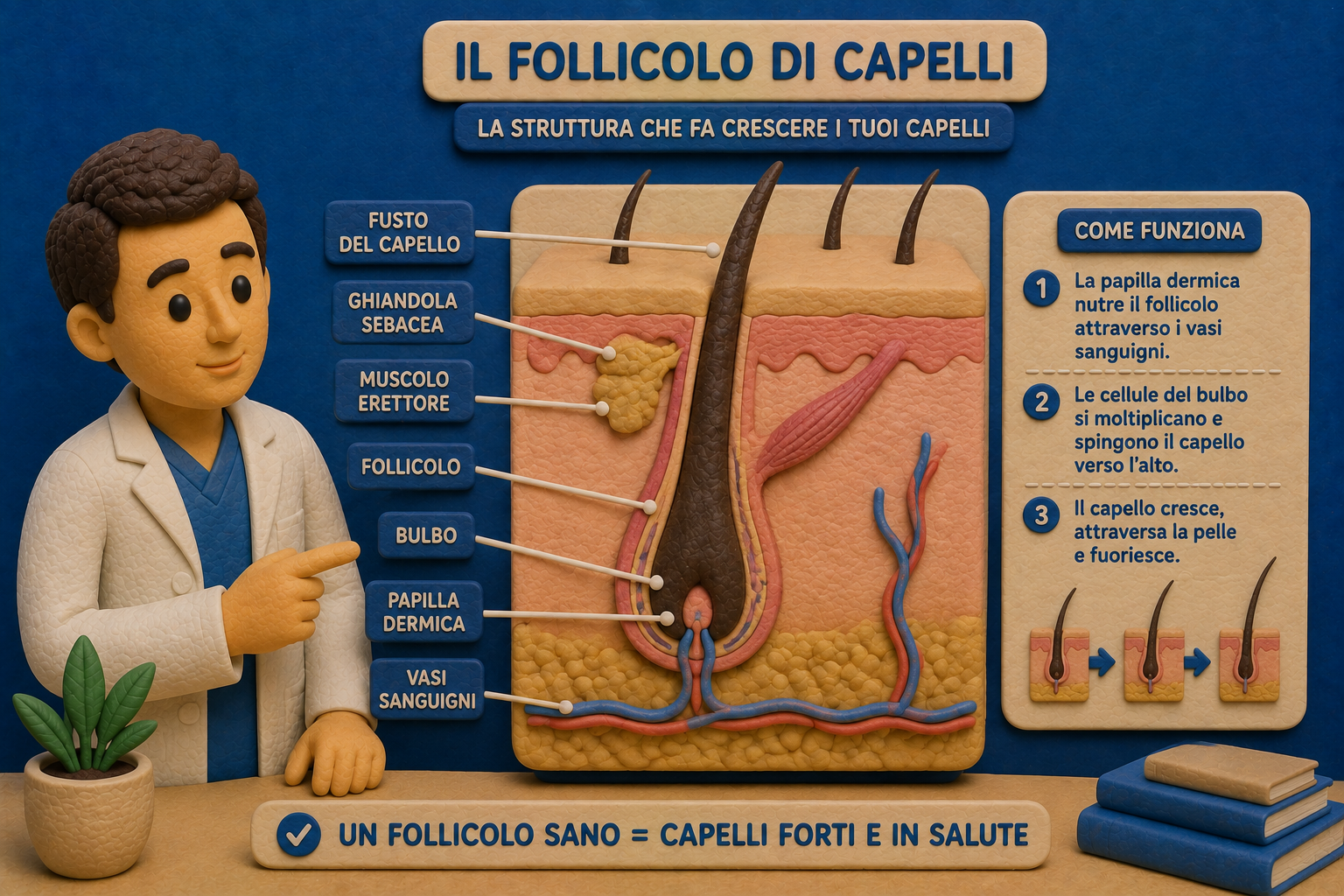
Beard and eyebrow transplants rely on the same technique as scalp hair transplants — extracting and re-implanting hair follicles — but the rules change almost entirely: required density, implantation angle, and even the type of follicle chosen are specific to each area.
This guide explains how these two procedures work, how they differ from a scalp hair transplant, and which questions to ask before choosing one.
In this article
What it is and who it's for
A beard transplant is aimed mainly at people with sparse or patchy growth (often genetic), scarred patches, or anyone who simply wants a fuller, more defined beard. An eyebrow transplant is requested both for aesthetic reasons (thin brows, or brows over-thinned by years of plucking) and to reconstruct the area after surgery, accidents, or certain forms of alopecia.
You don't need to be bald to get a beard transplant
Unlike a hair transplant, which in most cases addresses androgenetic alopecia, a beard transplant often involves patients with no hair loss condition at all: genetics simply didn't provide for dense growth in that area.
How it differs from a scalp hair transplant
| Aspect | Scalp hair | Beard | Eyebrows |
|---|---|---|---|
| Typical grafts per session | 1,000 - 5,000+ | 300 - 1,500 | 150 - 400 per side |
| Follicles per graft | Often 2-4 follicles per graft | Mostly single-follicle, for a more natural, sparser look | Almost exclusively single-follicle |
| Implantation angle | Follows the natural direction of scalp hair | Must follow the specific growth direction of each facial area (cheeks, chin, mustache) | Minimal angle, nearly parallel to the skin, to mimic natural eyebrow hair |
| Margin for aesthetic error | An angle error is often masked by the rest of the hair | Much more visible: the face is always exposed and close to the viewer's eye | Minimal: even a few millimeters of asymmetry are immediately visible |
This is largely why specific experience in beard or eyebrow transplants matters more than general hair transplant experience alone: the required manual skill and reference parameters differ from area to area.
Beard transplant: density and line design
A beard transplant works from a customized design of the area — chin, cheeks, mustache, jawline — that accounts for existing natural growth and facial symmetry. Each zone has a different growth direction: chin hair often grows downward, cheek hair more laterally, mustache hair at yet another angle. Respecting these directions is essential for a result that, once grown in, blends with the natural beard instead of looking like a separate patch.
Eyebrow transplant: precision and direction
Eyebrows are probably the area with the lowest margin for error among all hair transplants: they almost always require single-follicle grafts, implanted at a very low angle (nearly parallel to the skin), with a growth direction that changes along the arch — upward and outward at the inner corner, more horizontal in the middle, slightly downward at the tail. A design that isn't symmetrical to the face, even by a few millimeters, is immediately noticeable.
An eyebrow hair grows differently from a scalp hair
If the surgeon harvests follicles from the scalp (the most common source), keep in mind those hairs will keep growing at the pace and length typical of scalp hair: they'll need more frequent trimming than the rest of the natural eyebrow.
Where the follicles come from
- Scalp (back of the head): the most common source for both procedures, for texture consistency and minimal visibility of the extraction sites.
- The beard itself (for partially thinned areas): sometimes follicles are taken from denser beard areas to fill in sparser ones, keeping an identical texture.
- Body hair (in selected cases): a less common option when the scalp donor area isn't sufficient.
How the procedure works
- Anesthesia: local, generally well tolerated given the lower invasiveness compared to an extensive scalp hair transplant.
- Duration: 2 to 5 hours, depending on the number of grafts and the area treated.
- Technique: almost always FUE, for the greater precision required when extracting single-follicle grafts.
- Sessions: usually a single session is enough for both beard and eyebrow transplants.
Post-operative recovery
Small crusts and localized redness in the treated area are normal in the first few days. As with a scalp hair transplant, most of the transplanted hair falls out in the first few weeks (shock loss) before growing back permanently over the following months — generally between the third and sixth month for the beard, with similar timing for eyebrows.
Specific risks and limits
- Asymmetry: especially for eyebrows, where the aesthetic tolerance margin is minimal.
- Ingrown hairs, more common in the beard area due to hair texture and the treated zone.
- Uneven growth over time, if the transplanted follicles come from a donor area with different growth characteristics (e.g., scalp hair transplanted into eyebrows).
- An overly "drawn" result if the design doesn't respect the natural asymmetries already present on the face — a small degree of natural asymmetry is normal and should be preserved, not eliminated entirely.
Questions to ask the clinic
- Does the surgeon or team have specific, documented experience in beard or eyebrow transplants, not just scalp hair?
- How many grafts are realistically needed for my request, and where will they be harvested from?
- How will the line or shape be designed before surgery, and who approves it together with me?
- What happens if, over time, I want to change the density or shape achieved?