
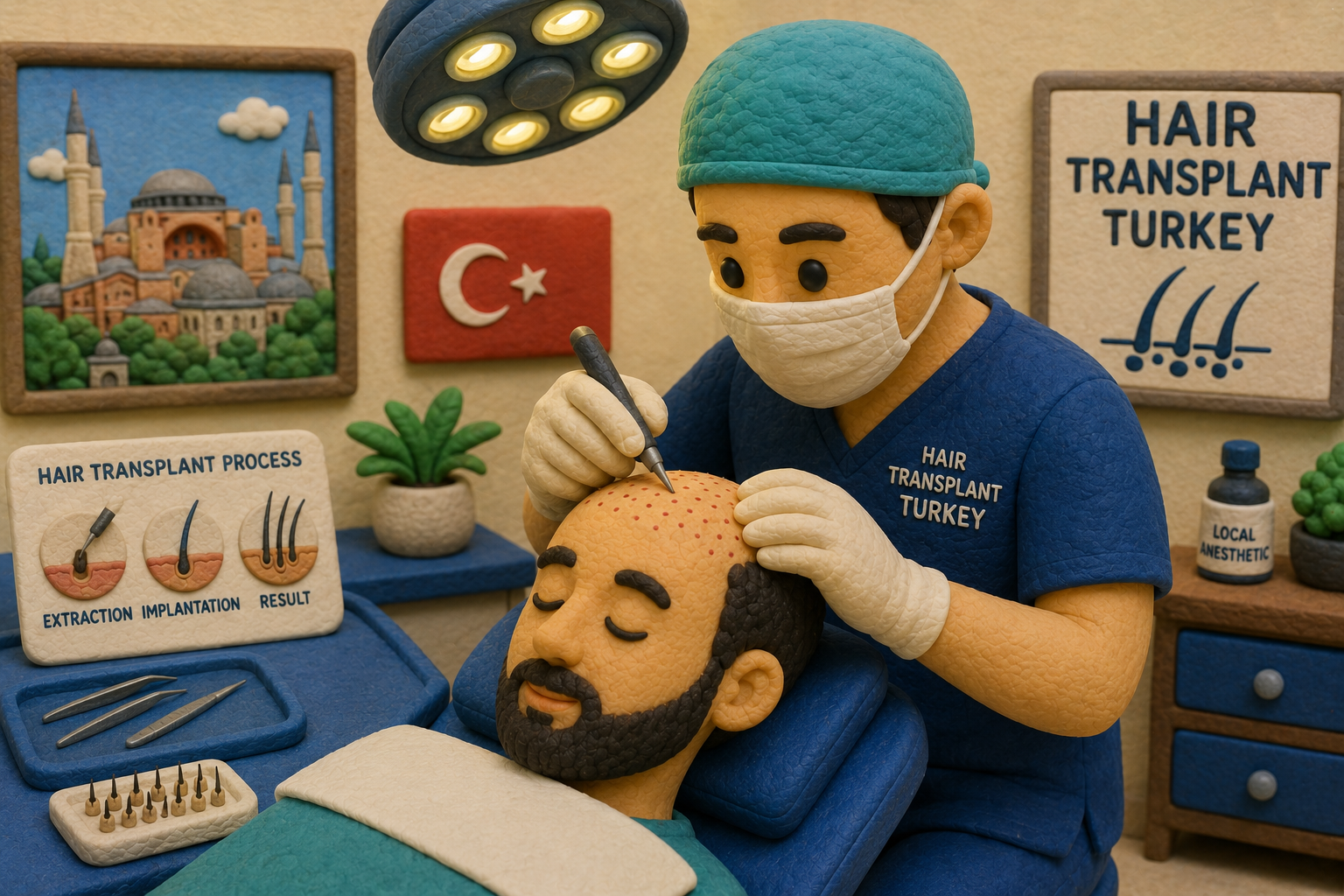
By number of procedures, Istanbul is today the world's hair transplant capital: several independent estimates suggest Turkey alone accounts for roughly a third of all procedures performed globally each year. This isn't a coincidence, and it isn't only about low prices.
This article explains the real numbers behind the phenomenon, the economic and political reasons that made it possible, why hyper-specialization matters as much as price, and which risks are still worth knowing before considering a procedure in Istanbul.
In this article
The numbers behind the phenomenon
Industry estimates vary considerably from source to source — partly because much of the market consists of private clinics reporting their own figures — but the overall picture is consistent: Turkey performs over a million hair transplants a year, a significant share of which (estimates suggest around 6 in 10) involve international patients who travel specifically for the procedure. Total industry revenue is estimated at several billion dollars a year.
- Istanbul alone concentrates most of the national volume, with estimates pointing to hundreds of specialized clinics active in the city — the highest concentration in the world in a single urban center.
- A significant share of international patients come from Western Europe, the UK and North America, drawn by a procedure cost often 60-70% lower than local price lists.
- The industry also generates significant spillover into hotels, transport and translation services, now an integral part of the "all-inclusive" packages offered by most clinics.
Why the numbers vary so much
There is no single, verified public register of every procedure performed in Turkey: many circulating figures come from industry associations, individual clinics, or news articles that in turn cite different sources. The numbers on this page should be read as orders of magnitude, not certified official data.
How Turkey's hair transplant boom started
The industry began growing in a structured way roughly 15-20 years ago, when the Turkish government chose to invest in medical tourism as an economic lever, encouraging the development of private healthcare facilities aimed at foreign patients. At the same time, the FUE (Follicular Unit Extraction) technique — less invasive than the traditional strip method (FUT) — was spreading internationally, and several Turkish surgeons helped refine its variants (including sapphire-blade techniques and DHI direct implantation systems), building a technical reputation that attracted further demand.
The result is a self-reinforcing cycle: more international patients arrive, more clinics open to serve them, price and hands-on experience competition both intensify — which in turn attracts even more patients.
Why it costs so little compared to Europe
- Exchange rate: the Turkish lira has sharply devalued over the past decade against the euro, dollar and pound. Clinics' operating costs, paid in lira, translate into much lower prices for anyone paying in a stronger currency.
- Lower labor costs: medical and non-medical staff salaries are lower than in Western Europe, the UK or the United States.
- Intense competition: hundreds of clinics in Istanbul alone compete on price, compressing margins.
- Economies of scale: clinics performing dozens of procedures a week amortize equipment and staff training better than a practice performing only a handful per month.
A low price doesn't automatically mean low quality
The structural factors above explain why a comparable procedure can cost a fraction of the European price without this necessarily implying lower quality. Price alone, however, says nothing about who will actually perform the procedure — a point we cover in more detail below.
Hyper-specialization: the volume advantage
Many Istanbul clinics don't practice general cosmetic surgery: they focus exclusively on hair transplants, often performing thousands of procedures a year. This hyper-specialization has a measurable practical effect: a team repeating the same type of procedure hundreds of times a month develops a level of manual skill and an ability to handle complex cases — limited donor areas, very extensive baldness, corrections of previous procedures — that's hard to replicate in a general practice that performs transplants only occasionally.
This is one of the reasons, alongside price, why patients from countries with high-quality healthcare systems still choose to travel to Istanbul: not only to save money, but to be treated by teams that perform that specific procedure extremely repetitively.
The rules do exist: the IHTA license and the 2023 law
Contrary to a common assumption, the industry is not unregulated. Since 2023, Turkey has had specific legislation on hair transplant units, requiring facilities to obtain a dedicated operating license, follow surgical safety protocols and hygiene requirements, and undergo periodic inspections by the Ministry of Health.
- IHTA (International Health Tourism Authorization): issued by the Turkish Ministry of Health, mandatory for any clinic, hospital or intermediary treating international patients — not an optional quality badge.
- Hair Transplant Units Regulation (2023): requires a specific operating license, staff training standards and periodic inspections.
- By law, incisions, graft extraction and implantation must be performed by a licensed physician — not by non-medical staff.
A license doesn't automatically guarantee the quality of a specific procedure
The existence of a national regulatory framework is an added layer of safety, but it only verifies that a facility is part of the official medical tourism system. On its own, it doesn't guarantee that the hairline will be designed naturally, that the donor area will be properly preserved, or that a doctor will actually perform the implantation on the day of surgery.
The other side of the coin: who actually performs the procedure
The most commonly cited risk from independent sources and industry associations involves so-called "hair mills": extremely high-volume clinics where much of the session — particularly graft extraction and implantation — is effectively performed by non-medical technicians, with the surgeon supervising for only a few minutes or not present at all. As noted above, this practice is illegal under Turkish law, which reserves incisions, extraction and implantation to a licensed physician — but industry sources agree it happens more often than the regulation would suggest.
Complications cluster in the "informal" market
A 2023 report by the ISHRS (International Society of Hair Restoration Surgery), the leading international scientific society in the field, found that a very significant share of globally reported complications came from clinics operating outside regulated channels — Turkey, due to its sheer volume, is one of the most affected areas in absolute terms. This doesn't mean the risk applies to every Turkish clinic, but that the variability between facilities is very wide.
How to navigate thousands of clinics
- Check that the clinic holds a valid IHTA license and the specific hair transplant unit license.
- Explicitly ask who performs extraction and implantation, and whether the surgeon will be present for the entire session or only part of it.
- Be wary of quotes with an "unlimited" graft count set before a direct examination of the donor area.
- Look for verifiable reviews 6-12 months after the procedure, not just photos taken in the first few days, when the final result isn't visible yet.
- All else being equal, prefer surgeons and clinics with years of documented experience specifically in hair transplantation, not just cosmetic surgery in general.